Residential ant infestations inside Franklin County homes rarely stem from an isolated group of foraging workers. Instead, foragers establish chemically marked trails leading directly from established outdoor…
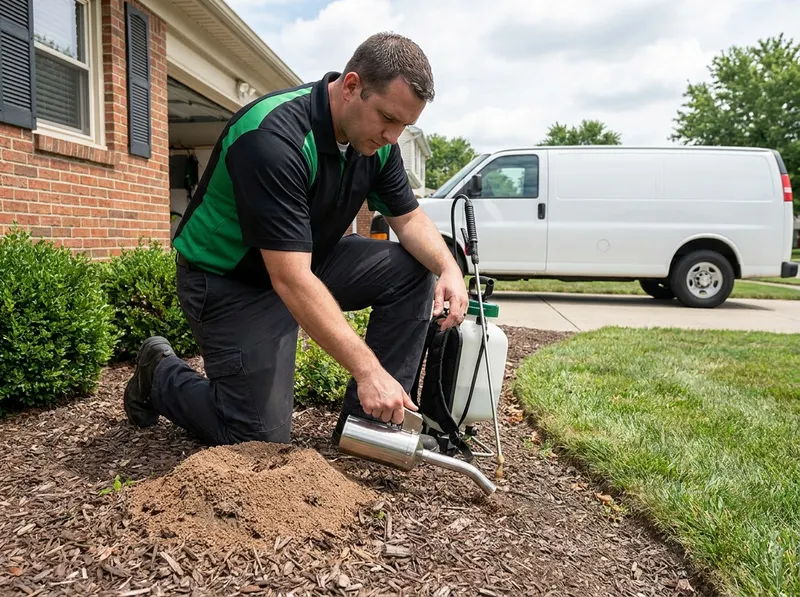
Residential ant infestations inside Franklin County homes rarely stem from an isolated group of foraging workers. Instead, foragers establish chemically marked trails leading directly from established outdoor supercolonies or subterranean nests into pantry baseboards, wall voids, and subflooring. Over-the-counter pyrethroid contact sprays aggravate this problem through a biological defense mechanism known as budding: when worker ants detect immediate mortality toxins on a trail, the stress induces secondary queens to fragment into multiple smaller sub-colonies dispersed deeper into wall cavities.
Systematic ant colony management replaces aggressive, localized spraying with an integrated barrier framework that treats infestations as structural hygiene disruptions.
Regional environmental conditions heavily dictate colony movement across Central Ohio. edu/ef603">University of Kentucky Department of Entomology).
These wood-destroying insects excavate structural framing without consuming the cellulose, generating fine sawdust piles near baseboards. In older brick masonry foundations throughout Olde Towne East and Grandview Heights, pavement ants establish dense subterranean galleries beneath stone walkways and crawl spaces.
Controlling these species requires an understanding of chemical classification and environmental safety.
Standard extermination practices often rely on heavy chemical applications that compromise indoor air quality. In contrast, target-specific bait matrices leverage natural trophallaxis, the mutual exchange of regurgitated food among colony members. S.
Environmental Protection Agency safety benchmarks, transferring the lethal dose directly to reproductive queens and developing larvae over several days.
Deciding between targeted colony management and preventative seasonal perimeter defense depends entirely on structural evidence. If foraging workers appear exclusively along exterior garden beds or patio flagstones, an exterior perimeter barrier is sufficient to repel nesting incursions.
However, when foraging occurs continuously along indoor countertops, plumbing chases, or basement band joists, interior baiting combined with structural void treatments becomes mandatory. While localized baiting requires a brief 7-to-14-day clearance window during which worker traffic remains visible as baits are distributed back to the nest, this gradual process ensures permanent colony collapse.
Surrounding foliage and regional conservation reserves like Whetstone Park of Roses and Franklin Park Conservatory and Botanical Gardens sustain vast outdoor insect reservoirs.
S. gov">Ohio Department of Natural Resources. S.
html">National Institute for Occupational Safety and Health. Homeowners experiencing active foraging inside living areas can arrange a service dispatch by contacting HarborStone Pest Care at (380) 255-6018.
Every job gets a firm, written price after an on-site visit.
Tell us about your ant colony management job in Columbus and we'll send a clear, written quote, usually the same day.
 HarborStone Pest Care